
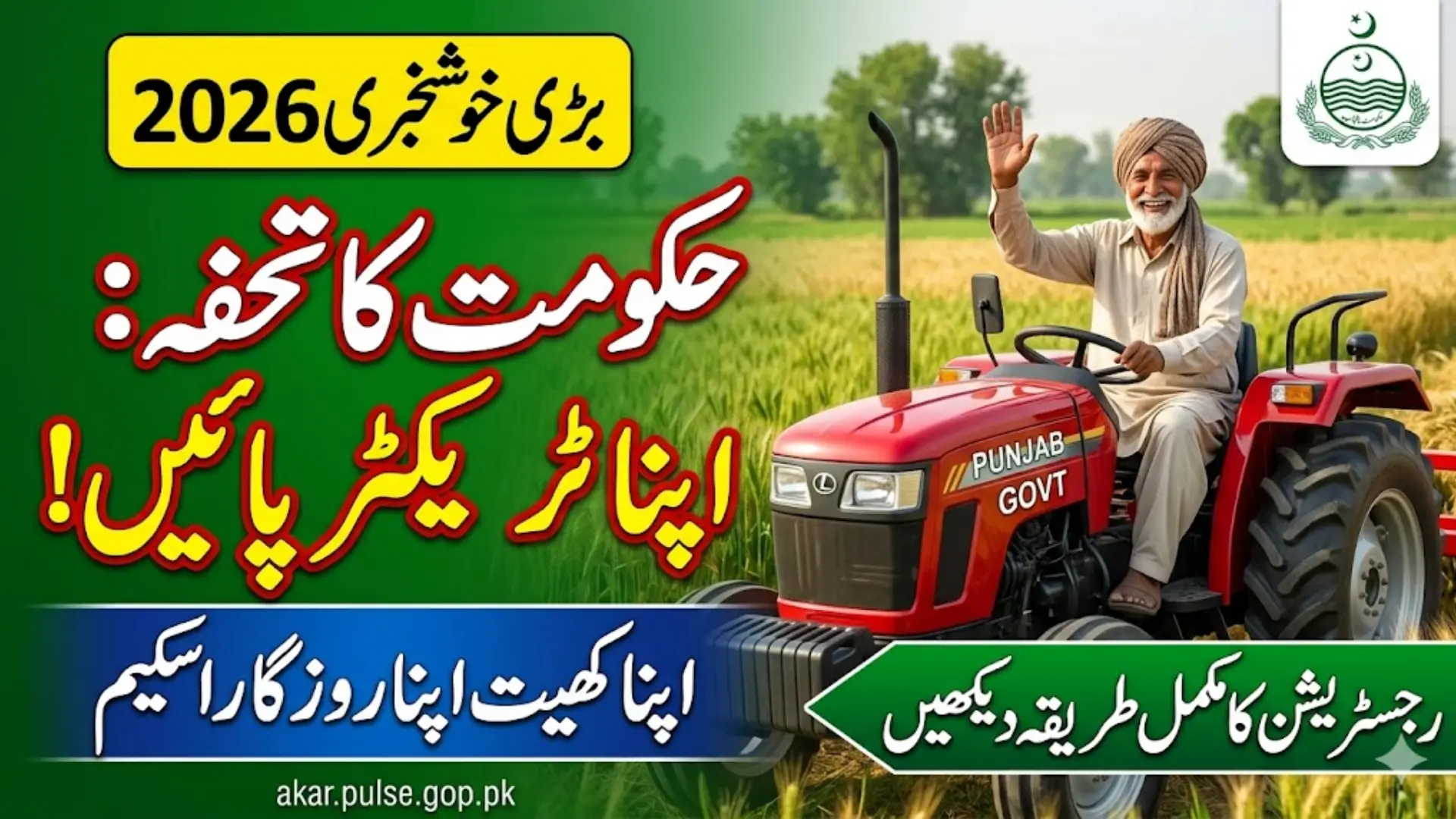
Akar Pulse GOP PK Registration 2026
Akar Pulse GOP PK Registration 2026 When I first heard about the Apna Khet Apna Rozgar scheme, I decided to talk to some farmers in Punjab who had actually tried it. What struck me was how real this opportunity is for people who work the land every day. This isn’t just another government announcement it’s a genuine chance for Pakistani farmers to improve their lives. Let me walk you through everything you need to know about registering for this scheme through akar.pulse.gop.pk.
When farming costs keep rising, a simple farmer can barely afford to buy a tractor anymore. That’s where this scheme comes in. Apna Khet Apna Rozgar, which literally means “Your Field, Your Income,” is Punjab’s government-backed initiative to help farmers access modern machinery without breaking the bank.
I’ve spoken to farmers in Okara and Faisalabad who benefited from earlier versions of this program. They all said the same thing: getting a tractor with subsidy support changed everything. Their crops came in on time, their yields improved, and they didn’t have to depend on expensive daily labor rates. This 2026 version is going online completely, which means you won’t need to visit offices multiple times or worry about dealing with middlemen.
The core idea is simple the government helps you buy a tractor through subsidies or easy installment plans. You focus on farming better. Here’s what you should know at a glance:
| Detail | Information |
|---|---|
| Scheme Name | Apna Khet Apna Rozgar 2026 |
| Province | Punjab |
| Main Benefit | Tractor & Modern Farming Machinery Support |
| Registration Method | 100% Online |
| Official Portal | akar.pulse.gop.pk |
| Target Group | Small & Medium Farmers |
| Expected Land Size | 5 to 12 Kanals Preferred |
| Current Status | Registration Updates Coming |
Why Farmers Are Desperate for This Scheme Right Now
Let me be honest with you—farming in Pakistan isn’t what it used to be. The costs have gone up so much that a lot of young people are leaving agriculture behind. Tractors that were once a one-time investment have become luxury items for many farming families.
I visited a village in Multan where a farmer named Khalid told me he couldn’t afford to buy a tractor even though he inherited good land from his father. He was hiring labor on daily wages, which was eating up half his profit. Then he got selected under the scheme, and suddenly, he had his own machinery. He could also rent it out to neighboring farmers and make extra income. This is the kind of transformation this program can bring.
The key reasons farmers are waiting for this scheme:
- Reduced equipment costs – Instead of paying the full price, you get a subsidy that covers a significant portion
- Faster farming operations – Modern machinery means you can prepare and sow your fields much quicker
- Better crop quality – Timely operations mean better crop outcomes and higher yields
- Lower labor dependency – You don’t have to hire expensive daily workers for every farming operation
- Extra income potential – You can rent out your machinery to neighboring farmers during off-season
- Pathway for young farmers – It creates opportunity for the next generation to stay in agriculture
Understanding the Eligibility: Can You Apply?
Not every farmer can apply for this scheme, and that’s where a lot of people get confused. Let me break down what the government is looking for. While final rules come with official notifications, here’s what you realistically need to qualify.
First, you need to be a permanent resident of Punjab. If you live in Karachi or Lahore but own land in Punjab, you can still apply—just make sure your address registration is correct. Second, you should be an active farmer, not someone who owns land on paper but doesn’t actually cultivate it. Third, your CNIC must be valid and current.
Here are the eligibility criteria that matter:
- Must be a registered resident of Punjab – Living and working in the province
- Active farmer status required – You should be currently engaged in agriculture
- Valid CNIC is mandatory – Your ID card must be current and correct
- Active mobile number needed – For receiving OTP and important notifications
- Land ownership or farming rights – You need to prove you have land to farm on
- Preferred land size: 5 to 12 kanals – Though this varies by region
- No previous government subsidy conflicts – You shouldn’t have received similar benefits recently
- No false information – Providing incorrect details leads to automatic rejection
What I’ve seen from talking to officials is that they’re becoming stricter about verification. If your CNIC doesn’t match your land records, or if your mobile number has been inactive, you might face delays. So be absolutely honest and accurate with every detail.
Documents You Must Prepare Before Applying
Here’s where a lot of applications fail—incomplete or unclear documents. I’ve met farmers who got rejected because they sent blurry photos of their CNIC or used old copies of land documents. It’s heartbreaking because they were otherwise eligible.
The good news is that the online system doesn’t require you to visit offices. The bad news is that you need to have everything ready digitally. All your documents need to be clear enough that a computer can read them properly. That means good lighting, straight angles, and no shadows when you take photos.
Make sure you have all these documents ready before you start the online application:
Identity Documents:
- Clear photocopy of your CNIC (both sides are important)
- Recent passport-size photograph with proper lighting
- CNIC number written clearly and verified
Land-Related Documents:
- Original land ownership document (Fard-e-Malkiat or Mutation record)
- Land record number (khewat/khatauni details)
- Proof that you’re the registered owner or have legal farming rights
- Survey document if available
Contact Information:
- Active mobile number (currently in use and receiving calls)
- Active email address (for important notifications)
- Correct bank account details (if government provides direct deposit)
Agricultural Information:
- Details about current crops you grow
- Land area in kanals (be accurate—don’t estimate)
- Type of farming equipment you need
- Current farming challenges you face
Step-by-Step Guide: How to Register on akar.pulse.gop.pk
Let me walk you through the entire process like I’m sitting next to you at an internet cafe. I’m breaking this down into simple steps because the portal itself can be confusing if you’re not tech-savvy.
Step 1: Visit the Official Website
Open your browser—Chrome, Firefox, or even Opera works fine. Type in akar.pulse.gop.pk exactly as it is. Notice the “pk” at the end. I’m mentioning this because fake websites with similar names exist, and scammers are waiting for people who make typing mistakes. Bookmark the correct page once you find it.
The website should load with the official Punjab government logo. If it looks suspicious or has spelling mistakes, close it immediately. The real government site has professional design and official seals.
Step 2: Create Your Account Properly
Look for a button that says “New Registration” or “Register Here.” Click it. The system will ask you to enter your CNIC number. This is the most critical part—if you make even one mistake with your CNIC, the entire application gets stuck.
Your CNIC is printed on your ID card. For example, if your CNIC is 35201-1234567-1, enter it exactly like that with the dashes. Don’t type it like 352011234567l. One wrong character, and you’ll be locked out.
After entering your CNIC:
- Enter your active mobile number (the one you use daily and have balance on)
- Wait for the OTP (One-Time Password) to arrive via SMS
- Type the OTP into the field immediately—it usually expires in 2-3 minutes
- Create a strong password (use capital letters, numbers, and symbols like !@#$)
Step 3: Fill Out Your Profile Information
Once you’ve created your basic account, the system will ask for your personal details. Here’s where accuracy really matters:
- Full name: Write it exactly as it appears on your CNIC, including any middle names
- Father’s name: Also match your CNIC exactly
- Date of birth: Must match your CNIC and age should be at least 18 years
- Complete address: Don’t just write your village name. Include house number, street, village, union council, tehsil, and district
- Mobile number: The same one you verified earlier
- Email address: If you have one; if not, you can skip this
The system saves your information automatically, so if your internet cuts out, you won’t lose everything. But it’s better to fill everything in one sitting if possible.
Step 4: Provide Your Land Details
This section asks about the land you want to use for farming. Be honest and accurate here:
- Total land area in kanals: Write the exact amount. If you have 7.5 kanals, write 7.5, not 7 or 8
- Land location: Give full details about where your land is located
- Type of crops: List what you currently grow or plan to grow
- Land document type: Select whether you have ownership papers, a mutation certificate, or farming rights record
- Land document reference number: The official number from your land documents
Document Upload: Making Sure Your Files Are Clear and Acceptable
This is the stage where many applications get rejected, so I’m giving it special attention. The system is automated, which means a computer scans your documents. If the scan is too blurry or at the wrong angle, the computer might not be able to read it properly.
How to Take Good Digital Copies:
Use your smartphone camera—modern phones have good cameras. Make sure you have proper lighting. Take photos during daytime near a window, not under electric light. Avoid shadows falling on the documents.
For your CNIC, take one photo of the front side and one of the back side. Make sure all four corners of the card are visible in the frame. The text should be clearly readable. If you have a flatbed scanner, even better—use that for crystal-clear copies.
For your land documents, they might be old and yellowed. That’s okay, but the text needs to be visible. If they’re too faded, consider getting fresh copies from your patwari (village revenue officer).
Uploading Process:
The system will ask for each document one by one. Upload them in the formats it accepts (usually JPG or PDF). The file size limit is usually around 5MB per file. If your photo is too large, the system will tell you to compress it.
Before you upload, rename your files so you know what each one is:
- “CNIC_Front.jpg”
- “CNIC_Back.jpg”
- “Land_Document.jpg”
- “Passport_Photo.jpg”
This way, if there’s an issue, you’ll know exactly which file needs to be re-uploaded.
Step 5: Review Everything Before Final Submission
This is crucial. Before you hit the submit button, go through every field you filled. Check for spelling mistakes, wrong numbers, or missing information. I’m not exaggerating when I say that a single typo has cost people their entire application.
- Read your name exactly as you typed it
- Verify your CNIC number one digit at a time
- Check your mobile number
- Look at your land details again
- Make sure all documents are uploaded
The system usually shows you a summary page before final submission. Read that summary carefully.
Step 6: Final Submission and Your Tracking Number
Once you’re satisfied that everything is correct, look for the “Submit” or “Confirm” button. Click it. The system will process your application for a few seconds.
Then—and this is very important—you’ll see a Tracking Number or Application Reference Number. This is your proof of submission. Write it down, photograph it, and save it in your phone’s notes. You’ll need this number to check your application status.
Keep the tracking number somewhere safe. Don’t share it with anyone, even if they claim to be government officials. The real government won’t ask for it over the phone.
How to Check Your Application Status
After you’ve submitted, the waiting begins. I know it’s tempting to keep checking, but understand that processing takes time. These systems have thousands of applications to go through.
Checking Your Status Online:
Go back to akar.pulse.gop.pk. You’ll see a section that says “Check Application Status” or “View My Application.” Click on it. You’ll need to enter your CNIC number and your tracking number. The system will then show you where your application stands.
What Each Status Means:
| Status | What It Means | What You Should Do |
|---|---|---|
| Pending | Your application is received and waiting to be reviewed | Keep checking weekly; don’t worry yet |
| Under Verification | Officials are checking your documents and information | This is normal; wait patiently |
| Approved | You’ve been selected! | Wait for next instructions about receiving your tractor |
| Rejected | Your application has been turned down | The portal should show the reason; read it carefully |
| Balloting Stage | Multiple applicants exist; lottery will decide | You’ve passed initial screening; you’re in the draw |
| Balloting Result – Selected | The lottery drew your name! | Congratulations; follow the next steps |
| Balloting Result – Not Selected | The lottery didn’t pick you this time | You can reapply in the next phase |
Why Checking Regularly Matters:
The system sometimes sends notifications that get lost or don’t reach you. Checking once a week is a good habit. I’ve met farmers who didn’t realize their application was approved until weeks later because they didn’t check the portal.
Set a phone reminder for every Thursday or Friday to check your status. It takes only two minutes, and it ensures you don’t miss important updates.
The Balloting System Explained: How the Lottery Works
When thousands of farmers apply but the government only has a few hundred tractors to give away, how do they decide who gets one? That’s where the balloting system comes in. It’s basically a computerized lottery that’s designed to be fair.
I spoke to an official who explained that they use random selection to ensure no one can claim favoritism. Every eligible application gets an equal chance, whether you’re from a city or a remote village, whether you know influential people or not.
How the Balloting Process Works:
The government first filters all applications. They remove the ones with incomplete documents or ineligible applicants. The remaining applications—let’s say 50,000 farmers are eligible for 5,000 tractors—all enter the balloting system.
The computer then randomly selects 5,000 applications from that pool of 50,000. It’s like a digital raffle draw. The selected farmers are then informed through SMS and the portal.
Factors That Might Influence Your Chances:
While the lottery itself is random, some factors might determine if you even get into the pool:
- Land size preference: Farmers with 5-12 kanals often get priority
- Regional distribution: The government tries to spread benefits across all districts
- Application timing: Sometimes early applicants get advantages
- Previous government support: If you received help recently, you might be excluded to give others a chance
- Document completeness: Only fully documented applications enter the draw
After Balloting: What Happens Next
If your name is drawn, you’ll receive an SMS notification and see “Balloting Result – Selected” on the portal. Don’t get too excited yet—you still need to complete the next steps. The government will ask you to visit an office, verify your documents one more time, and complete some formalities.
If your name isn’t drawn, don’t lose hope. The government usually holds multiple phases. You can apply again in the next phase. Many farmers get selected in the second or third round.
Common Mistakes That Get Applications Rejected
I’ve collected stories from farmers about why their applications failed. Learning from their mistakes could save yours. These aren’t theoretical errors—these are things that actually happen.
Mistake #1: CNIC Number Errors
One farmer named Muhammad typed his CNIC as 35211-1234567-1 when it was actually 35211-1234567-5. One digit wrong. His entire application got stuck because the system couldn’t match his information with government databases. When he realized his mistake a month later, it was too late to resubmit.
The lesson? Type your CNIC slowly and carefully. Better yet, have someone else verify it after you type it. Copy-paste from a photo of your CNIC if your phone has that capability.
Mistake #2: Using an Inactive or Wrong Mobile Number
Ayesha applied using an old mobile number she hadn’t used in six months. When the system sent her OTP, she never received it because that number was disconnected. She couldn’t verify her account and couldn’t complete the registration.
Use the mobile number you actively use every day. Make sure it’s a number that receives incoming calls and SMS. If you recently changed your number, update it with your CNIC first at any nadra office.
Mistake #3: Uploading Blurry or Incomplete Documents
The most common rejection reason is unclear documents. I’ve seen applications rejected because the farmer took a photo of their CNIC at an angle, and the system couldn’t read the numbers clearly. Another farmer only uploaded the front of their CNIC, not the back. A third person sent a black-and-white photocopy instead of a color copy.
Take clear, straight photos with good lighting. Include all four corners of every document. Use color, not black and white. If you have any doubt about clarity, retake the photo.
Mistake #4: Wrong Land Information
Some farmers write that they own 10 kanals when their actual ownership documents show 8 kanals. Others write different amounts in different sections of the form. The system cross-checks everything, and inconsistencies lead to automatic rejection.
Before applying, carefully read your land documents and know your exact land size. Write the same number everywhere. If you have 8.75 kanals, write 8.75—don’t round it to 9.
Mistake #5: Submitting Multiple Applications
Two farmers I know applied twice because they thought their first application might have failed. The system flagged both applications and rejected them both. The rule is simple: one application per person. If you think your first application has an issue, contact the help desk—don’t just apply again.
Mistake #6: Trusting Fake Agents or Middlemen
This is a sensitive one, but it needs to be said. There are people out there claiming they can guarantee you’ll get selected. They ask for money upfront. This is 100% fraud. I’ve met a farmer who paid Rs. 20,000 to an “agent” who promised to get him a tractor through the scheme. He never heard from that agent again.
The government process is transparent and automated. No agent can guarantee your selection. No middleman can speed it up. If someone asks for money, they’re scamming you. Always use the official portal, and don’t trust anyone else.
Mistake #7: Not Keeping Records
Some farmers don’t save their tracking number or take screenshots of their submission confirmation. Months later, when they want to check their status, they can’t remember their details. Without proof of submission, they’re stuck.
The moment you submit your application:
- Write down your tracking number
- Take a screenshot of the confirmation page
- Note the submission date and time
- Save the portal link in your bookmarks
These records are your proof if any issue arises.
Important Tips to Maximize Your Chances of Success
Based on conversations with successful applicants and government officials, here are practical steps that actually work.
Tip #1: Prepare Everything Offline Before Applying
Don’t apply spontaneously. Spend a week gathering all documents and information. Write down your CNIC number, land details, and other information on paper first. Verify everything multiple times. Only then sit down at the computer and apply. This reduces mistakes dramatically.
Tip #2: Apply as Early as Possible
When the government opens the portal, a wave of applications floods in immediately. According to officials, early applications sometimes get slightly faster processing. This doesn’t mean they get priority in the lottery, but it means you’re in the system from day one.
Set a reminder on your phone for the opening date. Be ready to apply within the first few days.
Tip #3: Ensure You Have Stable Internet
If your internet cuts out in the middle of your application, you might lose some information or the application might submit partially. Use a stable WiFi connection, not mobile data. Go to an internet cafe if you don’t have good WiFi at home.
Check your internet speed before you start. If it’s very slow, try a different location. An application that takes 10 minutes is fine, but one that takes an hour risks disconnection.
Tip #4: Don’t Use Internet Cafes with Bad Reputations
I’m mentioning this because of a real incident. A farmer applied at a cafe, and the operator secretly saved his information. Later, that operator tried to apply for a tractor using the farmer’s details. Only the farmer’s presence and real documents saved him.
Use internet cafes that are well-established and have customers you recognize. Better yet, if someone in your family is tech-savvy, apply from their house.
Tip #5: Keep Everything Private
Your CNIC number, your tracking number, your mobile number—don’t share these with anyone. Not with neighbors, not with relatives, not with anyone claiming to help you. There’s no reason a legitimate process would require you to share this information.
The government already has your number in the system. They don’t need you to provide it again to anyone else.
Tip #6: Have Your Documents Verified by an Official
Before you apply, visit your nearest patwari (village revenue officer) or tehsil office. Show them your documents and ask, “Are these correct and complete?” They’ll spot any issues immediately. This free verification step can save you a rejected application later.
Tip #7: Create a Backup of Everything
Take screenshots of your application form after you fill it but before you submit. Take photos of all documents you upload. Keep these in your phone or on a laptop. If there’s any dispute later, you have proof of what you submitted.
Understanding Current Portal Status: What to Expect Now
The portal status changes depending on government announcements and the current phase of the scheme. Let me explain what different statuses mean and what you should do in each case.
Status: Registration Closed
This means the current application window has ended. The government has received all applications for this phase. They’re now reviewing them and processing balloting. In this period, you can’t apply, but you can check your existing application status.
What to do: Wait for the next phase announcement. It usually comes 2-3 months after the current phase closes.
Status: Under Maintenance
The portal is being updated or fixed. You can’t access it temporarily. This could last a few hours or a few days. If this happens right before your deadline, contact the government’s help desk—they sometimes extend deadlines due to technical issues.
What to do: Check back the next day. If it’s still down after 24 hours, email the support address or visit an office.
Status: Next Phase Coming Soon
The government has announced that a new application window is coming. They haven’t opened it yet, but they’ve given an expected date. This is your time to prepare. Gather your documents, check your information, and be ready.
What to do: Get everything ready now so you can apply immediately when the portal opens.
Status: Applications Are Open – Apply Now
This is the green light. The portal is working, applications are being accepted, and you have a deadline (usually 30-60 days from opening). This is when you should apply.
What to do: Don’t delay. Apply within the first week if possible. More applications come in as the deadline approaches, which might slow the system down.
How to Stay Updated About Portal Status
Check the official portal every week, even if you already applied. Also:
- Watch local news channels—they announce important dates
- Call your local agriculture department’s help desk
- Ask your patwari if he has any updates
- Join local farmer groups on WhatsApp where people share information
- Check the official Punjab government website
Why This Scheme Matters More Than You Might Think
Let me share something personal. I grew up in a farming village, and I’ve seen how hard farming life is. I’ve watched farmers wake up at 4 AM and come back at sunset, and the income they make isn’t proportional to their effort. Modern machinery, like tractors, changes that equation.
When a farmer gets access to a tractor, it’s not just about finishing work faster. It’s about dignity. It’s about having time for family. It’s about youth not leaving villages. It’s about hope.
The Real Impact on Farmers’ Lives:
I visited a farmer named Hassan in Jhang who got a tractor last year. He said something that stuck with me: “Now, I finish my work in 5 days instead of 20 days. I spend the other 15 days with my children. I planted crops on time this year, so my yield was 30% better. I even rent my tractor to neighboring farmers and earn extra money.”
That’s what this scheme actually means:
- Time freedom: Work gets done faster, giving you time for family and other income sources
- Financial relief: Lower labor costs mean higher profit margins
- Better farming decisions: With time, you can focus on quality instead of just speed
- Self-sufficiency: You’re not dependent on expensive hired labor
- Youth retention: Your children see farming as viable, not something to escape from
- Community support: You can help neighboring farmers and build goodwill
Final Thought
I started this article by saying this isn’t just another government announcement. Having spoken to dozens of farmers and officials, I’m convinced. The scheme has real money behind it, and the online portal has real solutions for real problems.
If you’re a farmer in Punjab, this could genuinely change your situation. Not overnight, but meaningfully. The combination of reduced costs, better timing, and increased income is powerful.
Action Steps to Take Right Now:
- This week: Gather all your documents and verify your information
- Next week: Get your documents verified by a local official
- This month: Stay updated about the portal opening
- When it opens: Apply within the first few days
- After applying: Check your status regularly
- If rejected: Identify the reason and reapply in the next phase